Sunday, 23 November 2014

Perceptually infinite power


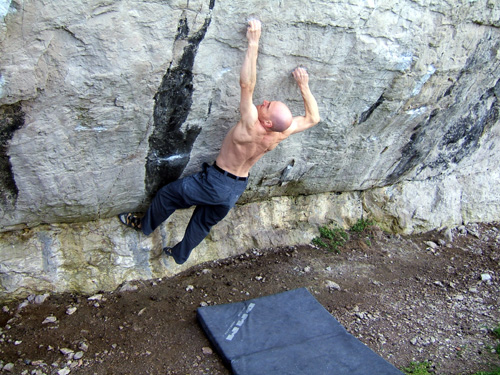
Now obviously, everyone has their physical limits. 
One can only apply x much force, as determined by our muscles ability to pull and our nervous systems ability to control that force when applied to situation y.

Think of it like a transistor. A pnp gate or similar. The device is rated for a maximum throughput of energy, of which the flow is controlled by another determinant (amount of energy into system). I think, the difference between our force mechanisms and a transistor is that we best apply control in recognisable patterns  from feedback, and we can change how much control is required to leverage so much force. This is all relative to how you try and apply the force, and how much power you think you have, perceptually

I am sure you will see a pattern in my style of thinking, but if you can convince yourself you have a possibly infinite amount power relative to your ability to harness it, you will probably be able to kick out those extra few measures of energy, which may translate to those last 3 moves through the crux and into the victory lap. Its all about gurning, gritting the teeth and really putting the extra 99.99% of possible effort, on top of the 99.99% you are already using. This is when you can make your body do things that scare you. You surprise yourself, and can pull off those sequences that seemed impossible. 

As I started up from the ledge at the pitch going up and right, I though nothing. I just had the move set I knew in my head. I had dogged through some of the harder sequence, but not move to move. The rope was in the first two bolts, so I was happy to have a go at the first hardish moves. 
I started up though the first 3 clips of moves, and after a few grunts managed to hang the horrendous back-three sharp camming stacked pocket. Shocked that it held, I grimaced through the next little balance sequence, and then clipped the 4th bolt. moving left I hesitated with my feet 'how was I here'. I powered through to the split pocket, move feet, pull, 'I can't feel my left back-three', more hesitation, power out. 

A standard scenario for most. If I hadn't hesitated, I probably would have made my first 7c route, on the first day of play, with little fuss. I will never be a Steve McClure. But I had really put all the beans in, chips down on the table, and made a solid effort. I pushed once again beyond what I though I was capable of. This had thrown me a little, but it is simply a case of learning to deal with it. Much like the fear. Finally today I had climbed beyond my level, above the bolts, and had accepted I was going to fall at some point or another. Much improved!
From my experience I feel we need to learn to do hard moves well individually, and teach the nervous system how to apply maximal force in as many given scenarios as possible. Further more, we need to teach the un/conscious versions of ourselves, to push just that much harder, every time.

I still feel that bouldering is crucial to hard climbing, of any form. Be it on any medium.

Saturday, 8 November 2014

So... that training plan.. and The Tor.

Its been a busy, busy week. But I am getting there.
Today I went back to Raven Tor for the first time since maybe April (which was a washout session).

After some pinches wall fun, we decided to actually get heads down and put some time into the powerband. I had tickled it before once or twice in passing, but had never decided to 'get on it'.

This proved highly successful, as I got a foot plan together and made it into the LH pocket which you drop into before the final section (over half way). I didn't manage the drop, but from not really having a plan at the beginning of the session and a reasonable amount of work, I am super happy with that progress. I think < 10 sessions and some slightly focussed training will see me tick this to get a F7c under my belt.
The biggest problem with working this problem, is the LH crucial slot, which is held while you do 3 RH/foot moves to a good pinch, a bad pinch and some footwork/twisting, before going LH to the pocket of the working crux. I re-adjust on this pocket, and really get the tip of my index finger into a good jam. The downside of this is that my skin takes a real beating on these moves, and working that section in so many laps caused a good hole to form.

Once the hole occured, working the problem became pointless because the handholds became painful. So I knocked that on the head and walked up the hill to join those on the weedkiller traverse.
I managed to do 5 good laps of this problem, always getting to (but not completing) the very final move to the incut jug. Every time I fell was because I didn't have the juice to commit to that last big pull, or the get in a better body position without letting go. I even got strait back on after one drop, and made it to the top jug.

From this I have realised some great progression, which coupled with time at Malham recently has made me a happy and focussed climber. You just need to ignore the sneering grit enthusiasts who will spend years punting to the 7a - b level, and just get on with climbing/training. And for those who haven't got the time to climb 24/7, training does seem to be worth the 30 - 45 mins a session it costs.

So I need to sort out a bit of bicep strength, one-arm deadhang slopers / v.slopey pinches, and start to really maintain and reduce time between harder problems. 7mins rest per go on powerband felt just about right, with 15 mins every 10 - 15 goes.

Monday will be a rest day, due to other commitments.
Tuesday will be one-arm deadhangs on the good beastmaker slopers. Classic 7on 3 off 6 sets.
Wednesday will be working on the harder indoor problems i.e. blue/yellow/white (and some top-end oranges). Limited rest for difficulty, 3 - 4 mins per attempt (4 goes at dogging a move with 45s rest between counts as one attempt in this model). 5 - 10 mins rest per 20 laps.
Thursday will be light volume and an easy lockoff session.
Friday is work, followed by the indoor boulder comp. Not to fussed, but will be good to chat to some of the better locals that I don't see so often. Plus free beer.
Saturday is work and rest.
Sunday is flexible, but work starts at 00:30 Sunday night / Monday Morning for a few hours.

The rest of Monday will probably be spent resting/doing uni work, and I may go to the wall but it isn't very likely.
The rest of the week will see a similar pattern I expect, except Friday will be a climbing day, Saturday will be rest and then should be out with Zippy on Sunday, either at Malham or at the Tor.

Coincidently, it seems that the final aim at Malham for the year 'something stupid' 7b(+really) is pretty soaked at the moment. In the instance this is the case and we show up to Malham that day, I will work on the upper part of Seventh Ardvark, into the hole on Bat Route, which from the ground is an 8b link. 4 extra moves on top of the 7b... a Font 7b+ boulder problem?

We will see...

Coincidently, I am going to start looking more at brain training for Focus. I want to develop myself better mentally, to just switch off from everything outside of the specific act of climbing this particular thing, so that I can be truly focussed and really improve. If you know of anything to help/guide this, please comment.

Also... I am starting to get psyched some more, which is always good.

Sunday, 2 November 2014

Well, it feels like time for an update

It even turns out that I didn't manage the last post, and it has sat in drafts in a sorry sort-of-started state.

So I went to Malham cove for three days with Zippy a couple weeks ago (before the trip to North Wales). I have been back twice since, and each time I seem to get some more mileage under my toes.

On the weekend trip:
I had never been climbing at Malham before, and had walked under it once ages ago. Thus, I had no idea what to expect. My fingers had sort-of healed up, and the ankle, but I haven't done a massive amount of climbing outdoors in ages. Particularly with how the summer went. Sometimes I think I just need to doss out for 3 months during a climbing season, and get good...

Anyway.

I basically spent three days top-roping/seconding the classic sport routes in the bottom of the 7s. Against the grain/Yosemite Wall
7th Ardvark
Rose Coronary
All great! 7th Ardvark took more time than the others, but suited my style and once I had found an intermediate gaston in the crux, it was over quickly. I struggled on 'something stupid', but managed to shock myself into flashing sections of it on the first touch.

I approached the weekend in an optimistic way, but with no expectations of preconceptions of glory.
I tried to take the 'what would I imagine Steve Mclure would do' mentality of cool, calm, collected, technical, preplanned and meticulous detail/precision to everything I tried (all be it on top rope). The approach to 'finding the ideal position where each move is as easy as possible', was bang on and made those three days a magical new and eye-opening experience. Malham had become (and still is) by far my favourite sport crag.

I left that long weekend with a renewed enthusiasm for climbing, and a want to train to get stronger. I will pick up technique and good movement/confidence as I go, but I need to focus on strength while I am still before my absolute peak.

I tried a few training sessions with various plans, but always felt too tired for the next 2 or 3 days to do anything worthwhile. Plus, I was eating properly. I think I need to write myself a new, more realistic plan that will let me do an hour a day, and build up towards split sessions over a long time.

I have been back to Malham twice since that weekend, and each time I have managed another three routes, including leading THE 6a+ this weekend. Although, my accuracy and technical quality has been dulled, in replacement for trying to pull harder. I also went this Saturday, feeling a bit sore and tired still from the previous Thursday. I need to sort this out and become reconditioned with more work. I also need to keep doing full stretching routines, as I am convinced they aid recovery speed/quality alot! Get on that yoga stretch thing at the end of your climbing session.

This does not solve the problem of loss of technique however. My next session at Malham, or even in the peak at Garage Butress etc, will mainly be focussing on body position. I will aim to find the best continuous body positions, using loads of drop-knee/Egyptian shenanigans, in order to technique and finger-strength my way up the wall, as opposed to pulling hard with ze arms. I am sure this is all dead obvious.


With my final year of university now into full swing, I feel I need to start really knuckling down and focussing of time management. I have been doing so, but I need to start factoring climbing into that management. So I plan, every day from Tuesday (and maybe tomorrow), to climb from 8 - 10. I will warm up for 30 mins, train for 30 mins and a reasonable intensity, project for 30 mins and then stretch and warm down. I will take time out from projecting if I have to, but my training will mainly be finger/core based on the wall, campus boarding, or maximal strength depending on the day and how I feel and what I have done previously.
I will post this plan up by Tuesday, and will explain why I chosen certain routines.

I have started to get out on the grit, now that it is coming into season. I will be spending time on the grit over the winter, for all the technique and footwork goodness. I am not all that bothered for shredding myself on some crap slopers, but it would be nice to potter about. I may even indulge in some easy trad, just the start becoming more well-rounded before the limestone season starts again next year.

I have been so busy as of late, that this blog hasn't been what I planned.
I will try and be more active on it, and start climbing more. This is just a very busy time in my life.

Sunday, 5 October 2014

Mapping the road to success... Assuming i succeed

My (modified) map to relative success


I have to assume I will be successful in climbing, but what it successful? What does it mean?
I am sure that definition will change over time with goals and experience.
For the moment, I think success for me is enjoying the process of developing and improving.
This post (which I will change over time) will be a roadmap towards my climbing goals. I may well add more branches as my interest changes. I will try and make a matrix map.

Green for Done
Blue For In Progress
Red for goal

Friday, 5 September 2014

Tis the change of season...

and everyone is getting ill.
I am already at stage two of manflu, when the cold heads from my throat to my chest and plays havock. 

Anyway

Pictures of people climbing some things 
On UKB there is some silly thread about the effect of running on climbing. I do not think (as far as I know) that anyone is really good enough at climbing in the world, for running to really have an adverse effect, under the caveat that you are used to both climbing and running, and know how to manage the volume and intensity of both activities to make them work together. 


With the longest sentence over, the best thing to come out of this thread IMO was someone posting this link to an interview with the legend that is Ben Moon. All of his suggestions make sense. Although his thing about goals opposes my opinion, they kind of fit together if you take his advice as my comment of 'managing the steps along the way'. 


One of the unifying elements I seem to have found from speaking to and listening to or reading interviews from all the best climbers is, they all seem to give the really obvious (and often concise) advice that you probably needed to hear. Dave Macleods 9 out of 10 and most other training resources I have come across that people seem to think work, all pretty much offer that sensible and obvious advice that you generally need someone to tell you.

This is the advice that you hear and think, 'That makes so much sense, and if I stick to that for at least a while then maybe it will work for me'. Not the kind of advice that says, "maybe this element of science taken from another source can be applied, and this will happen if you do these things" and similar.

What is great or interesting about this unifying coincidence?
The mindset of successful climbers. 

Some of the best climbers seem to have incredibly analytical minds. This advice is garnered with the consideration of all the systematically equatable aspects within the given problem, and boiled down into often concise results. A good example would be Dave Macleods 'get over falling' part of 9 out of 10, or Ben Moons 'Be patient and let it happen' and 'It's not good if you are not happy'.

Those dead obvious things which, are so obvious that you already knew, but someone needs to remind you of.

I am putting this here to remind myself of these simple pieces of advice, that I just need to remind myself of every once in a while. 


  • LITTLE AND OFTEN
  • ITS NOT GOOD IF YOU ARE NOT HAPPY
  • BE PATIENT, LET IT HAPPEN
  • KNOW WHAT YOU WANT TO DO AND WORK FOR IT
  • TAKE FALLS, LEAVE YOUR EGO AT THE FLOOR
  • VIEW PROBLEMS ANALYTICALLY - IF THAT DOESN'T WORK, TRY SOMETHING ELSE
  • HARDER DOESN'T ALWAYS CLASS AS SOMETHING ELSE
  • DON'T KEEP TRYING THE SAME THINGS THAT DO NOT WORK RIGHT NOW
  • 1MIN REST PER HARD MOVE
  • 8 HOURS OF SLEEP FOR SUCCESS
  • BIG SYSTEMS ARE MADE OF MANY TINY COMPONENTS, YOU CAN MAKE A CPU FROM NAND GATES IF YOU WANT
  • THINK CONFIDENT CLIMB CONFIDENT, THINK SHIT CLIMB SHIT
  • A TRAINING SESSIONS SHOULD BE PHYSICALLY AND MENTALLY HARD - ENJOY SUFFERING

    I will try and add more over time. 

Saturday, 23 August 2014

An apt time for goal review?

Goals, and what they mean.

Every year I seem to watch (or go to) Reading Festival and stand in awe, wishing I had stuck with music school and had a chance of ever gracing the stage. I then realise that was a ridiculous thing to think, and feel slight envy towards those who have managed to get there while I am stuck here (wherever that is). Goals are a necessary evil in this world, forever dragging you in one (or many) direction(s), until you (might possibly) get there, at which point you realise the goal wasn't far enough and you need to aim higher. The flip side being you never make the goal, get lost or otherwise move in another direction. Is that true failure, or reaching towards your full potential in another medium?
Lets go back to the start, and take a personal comparison between my working and climbing careers.
In the early days

Where it started.


6 years (or so) ago, I begun a long and arduous journey into a career in the events industry.
I started with no direction, not a clue of where to go or where I wanted to end up.
I did however work (bar) at a venue which was down a sound engineer, and with the support of a few local professionals, started mixing bands.
At my first venue
One of my first grit climbs
One of my first A grades
I was fresh out of college (asked to leave) without a clue of what I wanted to do with my life (like most 18/19 year olds), and it all seemed pretty bleak.

Present day; I am 3 or so venues better off and about to enter the final year of my degree, BSc Sound, Light & Live Event Technology at Derby University. I have been working over the summer at my first hire company (excluding freelance at On! in Notts), which has mostly been staging and roof system work. This isn't really my goal, but is a step somewhere towards the general direction I want to go to.

At some point I decided my goal was to become a sound engineer, which is a bit of a rubbish goal as it isn't very specific. I could have called it quits after about 6 months and said 'goal accomplished'. I have since made my goals more specific.

I then decided I want to work at a larger venue, and accomplished that, although not as a sound engineer directly. Having mixed a few larger events, I still do not class this as an accomplished goal. It was however superseded, when I decided I want to work as a system tech (ideally) or a mixing engineer for a larger production company (Skan, SSE, Adlib etc etc). If I accomplished this goal, I would want to go on a few tours and that would be good stuff. This goal is certainly still unaccomplished, but not totally impossible.

To get to the larger production company, I decided (with the persuasion of my 'then' mentor) to go a study a scientific degree in this field. From where I started (having missed out an intensely large proportion of the story) I am a very very long way into the journey, but infinitesimally small when compared to the goal and path I lay out before myself. It is important to remember that all things are generally made out of much smaller steps, like a cpu and logic gates. However, I still find myself wondering why I am not there yet.

If it serves for nothing else, starting the degree changed how I make, view and evaluate goals as well as view progression. I always need to remind myself that there are many steps on any road.
Hard at work. This was the most complex system I have worked on. A 16 channel surround sound system at Derby Theatre.


Climbing

With the start of my degree I started climbing. In the beginning my goal was to get to the top of the easy problems at the local climbing wall. When I could eventually do that (by this point I was hooked and climbing 4 days a week after uni), I decided I wanted climb everything and to learn to lead, and my then girlfriend taught me how to lead. I progressed through the local indoor problems fairly quickly.

 Next up I wanted to climb slightly better than the best locals at the wall. Unfortunately time is a killer and they had between 3 and 13 years experience on me, so although at a similar level, I am still not totally there. Although here is where diversifying comes in. I am not great at any form of climbing, but am better at peak lime than grit. They are mostly grit climbers (bar the total wads). 
My first DWS 

As I progressed in climbing difficulty, my opinions, training methods and the people I climb with changed. Although in the peak I climb with people who are much much better than at the local walls, climbing harder than them is still a goal (but not the top priority, just an immature fantasy). I have gone from nothing, to Font 7B to 7A (drop due to injury and work commitments, plus I find I am not really trying hard enough recently). 

My current way of making goals

My goals now sit at two distinct levels, attainable in the short to medium term, and pie in the sky. 

Currently my climbing goals are:
(realistic)
Climb a peak limestone Font 7b+
Climb a peak grit 7b (boyager)
Climb a parisellas cave Font 7b+
Climb a peak sport 7c+ (Taylor Made)
(pie in the sky)
Climb Belly of the beast into Evolution/Mutation
Climb Violent New Breed
Climb Voyager
Climb Brandenburg Gate
Climb The Pink Star
Climb Hubble


Not trying hard enough
Current career goals are:
(realistic)
Get a 1st for my degree
Get a job at one of the big audio companies (as listed above)
Finish my FPGA driven Audio over IP + PDM oversampling amplifier system
Do some work in venue design
Earn enough money to live comfortably and holiday, while still maintaining time to climb well.

(pie in the sky)
Get a job on 4 arena (or bigger) world tours (mixing or system tech)
Mix or system tech Reading festival headliner
Mix or system tech Glastonbury festival headliner
Design production package for 1 large dance festival
Design tour production package for 3 world tours
Design and build a bespoke large format stage/production package for one of the larger uk festivals
Design an arena sized venue (acoustics and technical equipment)


My goal at the end of the day, is to make enough money from what I am doing, to continue doing those things I love in good balance, with a solid future plan.

How Goals Shape You

This was once a goal, and is now an easy warm-up

I figured that you need to make goals that you could attain. These goals are specifically chosen to give you that minor boost of confidence every time they are completed, and to keep you developing in the given task elements.
By the same token, if you do not make goals that are way beyond your maximum potential, then surely you will never reach your maximum potential. As you reach the next goal closest to your limit, the next goal you make will have a lightly smaller push in difficulty than the last, and you will enter an infinite loop in infinitesimally smaller developments until you stagnate. If you do everything in your power and dedicate 100% of what you have into hitting a major unattainable goal, and you manage all the smaller goals on the way successfully, you are far more likely to hit your maximum potential. 

The trade off being that you may change direction, feel dissatisfied in the end and decide you wasted all your time. By then, if you look back at what you have accomplished, the sum of what has been accomplished will hopefully be more worth while than the end goal ever would have been. Its the bout the journey' philosophy with a specialisation twist.
Bigger stages, still small events

How To Evaluate Goals

If you do not regularly evaluate the goals, your progress and upon completion, you won't know where you are going, or where you have come from, or where you are at. 

If you complete a goal, then you may be onto a winner, but if you never evaluate, how will you know?
What worked? What didn't? You need to know. to continue.

If you do not complete, or choose to change a goal, is this because you are giving yourself the easy way out? Or is it because the goal isn't helping you progress?

I try to evaluate goals positively, a failure is feedback on how to move forwards, maybe in a slightly different direction. 
Things progress technically

Having had minor success, maybe this doesn't work or isn't the most efficient method of goal making and success pursuit. Maybe it wont work, but it is all I have on the topic.

This is all a work in progress.
Know where you have come from, and look where you are going.

Goals for me are way-points and direction and feel great at some times and punishing at others.

I will leave my future self with this little tit-bit of cold hard realism. People may help you, but no one will do it for you. I you want it that much, endure the hard work and pain it takes. 

Saturday, 16 August 2014

Font (late post)

Font was infact awesome.

I need to spend a couple  months there though, getting used to the style.
It wouldn't hurt to be good at climbing either.

Here is to the future dream.


Like Zippy said; If you don't like font, you don't like climbing.